Category Archives: Kidney Disease

Categories Health, Kidney Disease, Risk Factors

CKD Mangement

This article can help in understanding some general issues and the management of Chronic Kidney Disease:

Issues:

  • It is important to understand that CKD is a spectrum of disease. Mild CKD is common and rarely progresses to a more severe form and it does not necessarily equate to renal dialysis.
  • Understand eGFR and monitor it on a regular basis to ensure that the condition is not deteriorating.
  • Understand the link between diabetes and hypertension – maintaining a tight control can limit the damage of the kidneys.
  • People with CKD should exercise, achieve a healthy weight and must stop smoking.
  • A good glycaemic control should be achieved in patients with diabetes mellitus and CKD.
  • Review all prescribed medicines regularly.

Already Diagnosed: eGFR is less than 60

  • Review GFR and assess the rate of deterioration.
  • Review all medication including the over-the-counter drugs.
  • Haematuria and proteinuria suggest glomerulonephritis, this may progress rapidly.
  • Look for sepsis, heart failure, hypovolaemia, palpable bladder.
  • Repeat serum creatinine measurement to exclude rapid progression.
  • Seek professional help – there are safe and natural options to address this disease.

Monitoring:

  • Based on the severity of the disease, eGFR should be monitored regularly.
  • Have the level of proteinuria assessed at least annually.
  • Proteinuria should be assessed by measurement either of the PCR or ACR, ideally on an early-morning urine specimen.
  • An abnormal eGFR should prompt a clinical assessment and a repeat test within two weeks should be done to assess the progression.
  • Patient with CKD should have an annual assessment of their cardiovascular risk factors, lipid profile, BMI, exercise, alcohol and smoking habits.
  • Keep the systolic blood pressure below 140mm Hg and the diastolic blood pressure below 90mm Hg.
  • Routinely measure calcium, phosphate, parathyroid hormone (PTH) and vitamin D levels.
  • Renal dietitian should be consulted to carry out a dietary assessment and give individualized information and advice on diet.

Complications:

  •  Anemia: left ventricular hypertrophy, fatigue, impaired cognitive functioning.
  •  Coagulopathy.
  • Hypertension: left ventricular hypertrophy, heart failure, stroke, CVD.
  • Calcium phosphate loading: cardiovascular and cerebrovascular disease, arthropathy, soft tissue calcification.
  • Renal osteodystrophy: disorders of calcium, phosphorus and bone, most commonly osteitis fibrosa cystica.
  • Bone changes of secondary hyperparathyroidism: bone pain and fractures.
  • Neurological: uraemic encephalopathy, neuropathy including peripheral neuropathy.
  • Dialysis amyloid: bone pain, arthropathy, carpal tunnel syndrome.
  • Fluid overload: pulmonary oedema, hypertension
  • Malnutrition: increased morbidity and mortality, infections, poor wound healing.
  • Glucose intolerance due to peripheral insulin resistance.
Categories Kidney Diet, Kidney Disease

CKD and diet

Chronic kidney patient may need to make changes to their diet. These changes include limiting fluid, limiting salt, potassium, phosphorus and eating low-protein diet. Further changes in diet may be required if the kidney disease gets worse or a regular dialysis is required.

As the urine output may also be impacted, it is a good idea to limit the fluid intake in kidney disease patients. Without passing of urine, fluid can build up in the body and can cause fluid accumulation in heart, lungs and ankles.

You may consult your physician and/or dietitian about your ideal weight and design your diet accordingly. Weigh yourself often to keep track of your goals.

Protein: Your may be asked to go on a low protein diet before you start dialysis. This may change once the dialysis is started. People on dialysis may required to eat up to 10ozs of high protein food each day.

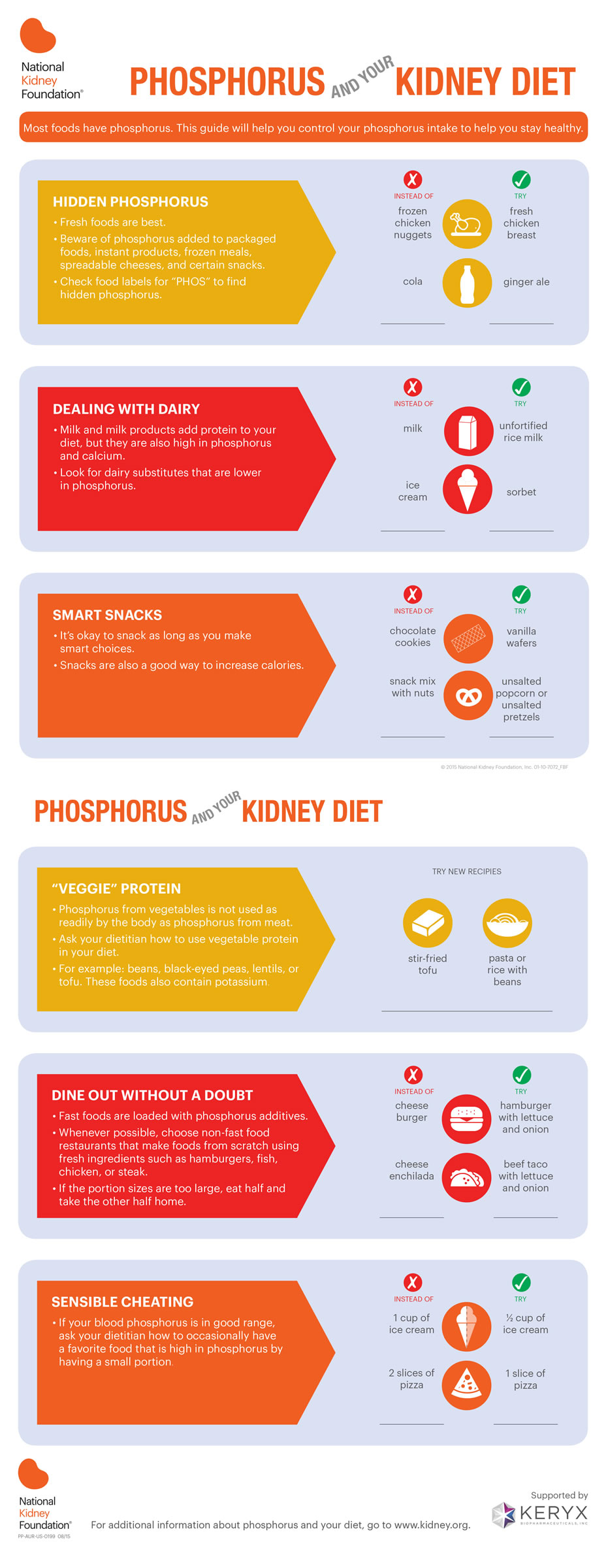
Calcium and Phosphorus: These two minerals go hand in hand and are checked very often in kidney patients. Even in the early stages of this disease, the level of calcium can go low and phosphorus can go high.

High phosphorus level can also cause itchiness and low level of calcium can cause body to pull calcium from the bones making them weak and easy to break. You may need to take calcium pills to prevent bone disease and take vitamin D to keep the balance between calcium and phosphorus in the body.

Dairy foods contains large amount of phosphorus, this includes milk, cheese, yogurt. You can look for labels where the dairy products have lower amount of phosphorus. To address high phosphorus you may also be prescribed the phosphorus binder.

Potassium: Potassium is another electrolyte that should be aware of. Fruit and vegetables are a good source of potassium. You will need to look for items that are low in potassium. Higher levels of potassium can cause dangerous heart rhythms.

Avoid orange juice, nectarines, kiwis, raisins, dry fruit, bananas, cantaloupe, honeydew, prunes, avocado, potatoes, tomatoes, pumpkin, spinach, asparagus as they are high in potassium.

In the early stage of the chronic kidney disease you may not be required to limit the intake of fluid however, as the disease progresses, you may be required to limit the amount of fluid you can drink. To avoid the thirst – you may avoid salty snacks and stay cool on hot days.

Iron: Advanced kidney disease can also cause anemia and patients in this case may require iron supplements. This can be addressed via iron supplements or by taking the Erythropoietin (EPO) injections.


Categories Health, Kidney Diet, Kidney Disease, Risk Factors

Red meat may trigger kidney malfunction – study

Crispy bacon, a juicy rib eye steak, or beef burger – these mouthwatering red meat delicacies have long been accused of being bad for health. Unfortunately, a new study based on 15 years of research now claims to back that theory with scientific evidence.

Risk of kidney failure significantly increases with constant red meat consumption, a new study conducted at the National University of Singapore suggests.

“Red meat intake is strongly associated with ESRD risk [end-stage renal disease, or kidney failure] in a dose-dependent manner,” the study’s abstract says.

More than 60,000 adults from Singapore took part in the long-term research. They were divided into several groups according to how much red meat they consumed. Constant follow-ups showed that around 1,000 participants developed kidney failure.

The people in the group claiming to eat the largest amount of red meat had a 40 percent higher risk of experiencing kidney failure compared to those consuming moderate amounts.

Luckily, not every type of protein has been found harmful to kidneys, and those who look after their muscles can still get their needed protein fix from poultry, fish, eggs, or dairy products, thus reducing the risk.

“Our study shows that red meat intake may increase the risk of ESRD in the general population and substituting alternative sources of protein may reduce the incidence of ESRD,” according to the study.

This, however, doesn’t mean that people should “avoid red meat like poison,” but finding a substitute for at least one meal with red meat a day is not a bad idea, the study’s senior author, Woon-Puay Koh, told Reuters Health in an email letter.

“Current guidelines recommend restricting dietary protein intake in patients with advanced chronic kidney disease to help reduce symptoms and slow progression to end-stage renal disease,” Koh also noted.

An estimated 500 million people suffer from chronic kidney condition, some of whom need constant dialysis procedures or a kidney transplant, researchers noted.

It was previously thought that people with kidney problems who eat red meat on a daily basis could encounter problems with a substance known as urea building up in their bodies, because if a person’s kidney’s aren’t working problem, it is not sufficiently expelled in their urine.

The new study stresses that there is no evidence that red meat causes kidney conditions, but it apparently contributes to the pathological process.

*article source – https://www.rt.com/news/353781-red-meat-kidney-failure/

Categories Health, Kidney Disease, Risk Factors

SEXUALITY AND KIDNEY DISEASE

Can people with kidney disease or kidney failure still enjoy sex?

It’s important to remember that people with kidney failure can have healthy marriages and meaningful relationships. They can fall in love, care for families, and be sexual. Staying intimate with those you love is important. It’s something everyone needs.

Many people think that sexuality refers only to sexual intercourse. But sexuality includes many things, like touching, hugging, or kissing. It includes how you feel about yourself, how well you communicate, and how willing you are to be close to someone else.

There are many things that can affect your sexuality if you have kidney disease or kidney failure — hormones, nerves, energy levels, even medicine. But there are also things you and your healthcare team can do to deal with these changes. Don’t be afraid to ask questions or get help from a healthcare professional.

What if I lose interest in sex?

Your interest in sex may change when you have kidney disease or kidney failure. At first, you may have less interest in sex. This can happen because you need a lot of energy to cope with the physical and emotional changes brought on by your illness. In time, your interest may return to normal.

Some men may find it more difficult to have or keep an erection. This is very common with kidney failure. It can result from the side effects of medicine, having a buildup of toxic wastes in the blood that may not be fully removed by dialysis, or other things. Many of these problems can be treated. Don’t be afraid to ask questions or get help from a healthcare professional.

Emotions can also affect sexual functioning. This includes stress, depression, nerves, fear of disability or death, marriage problems, and much more. For some people, having kidney disease may cause physical changes that can make them feel less attractive. This can also affect sexual interest. Couples who find that their sex lives are changing should talk to their doctor or social worker. Many of these problems can be treated.

Is sexual intercourse safe for kidney patients?

Some patients and their partners may worry that sexual activity could cause the patient’s death or harm the dialysis access or transplanted kidney. No limitations need to be placed on kidney patients sexually. If sexual activity does not place pressure or tension on the access site, it will not cause damage. Fear can cause people to avoid sexual activity needlessly.

After receiving a transplant, it is important to wait until the scar has begun to heal. Once your doctor says it is all right to resume sexual activity, there is no reason to worry about damaging the transplanted kidney.

For some couples, sexual intercourse is not possible. Some may feel that sex is not as important as it once was. Activities such as touching, hugging, and kissing provide feelings of warmth and closeness even if intercourse is not involved. Professional sex therapists can recommend alternative methods.

How will I know whether sexual problems are due to physical or emotional causes?

This requires a complete medical, psychological, and sexual history of you and your partner. Medicines should be reviewed for sexual side effects and changed if possible. Blood tests should include hormone levels and blood sugar levels to check for diabetes. Men can be checked to see if nerve and blood supply to the penis are good and if they can have an erection. If no physical problem is found, an emotional cause must be considered.

What can be done if the problem is physical?

Several options are available for men whose penis will not get or stay hard (erection). Penile implant surgery places inflatable or semi-rigid rods into the penis. In some cases, surgery can improve blood flow to the penis. If the man does not want surgery, male hormones may be given. Oral and injectable medications can cause an erection. External suction devices can make the penis hard enough for intercourse, but they require time and hand strength. Doctors with special training in impotence can give information on all options as well as their advantages, disadvantages, and side effects.

Women patients usually have less vaginal wetness and may have pain during sexual activity. Lower hormone levels can cause vaginal dryness. Use of a water-soluble vaginal lubricant can lower or stop pain associated with intercourse. Do not use petroleum jelly because it can increase the risk of infection. Some women may be unable to have a climax or may need more time to get “turned on” because of loss of energy, hormone changes, or medications for high blood pressure. A change in blood pressure medicine or extra hormones may be needed. Your doctor can provide information on options.

What can be done if the problem is psychological?

Feeling worried, anxious, or depressed is normal when faced with a serious loss such as kidney disease and kidney failure. These emotions can cause loss of energy and lower interest in many activities, including sex. If a sexual problem does occur, embarrassment and guilt often follow. Fear that the problem will happen again may cause the person to shy away from sexual situations. Relaxation exercises can help to control these fears. Regular physical exercise and activity help keep the mind busy and can improve physical condition and body image. If sexual problems continue, sex therapy can help. Even if the problem is psychological, some of the treatment options mentioned for physical problems may be helpful.

Can sex therapy help?

Sex therapy deals with the sexual problems of couples and individuals. The first step in sex therapy may be sexual education for the individual or couple. The therapist may assign activities to be done at home. These include communication exercises, stress reduction activities, and practicing ways of improving skills in giving and receiving enjoyable touches. Sex therapy can help with problems such as low sexual interest, trouble in reaching climax or reaching climax too soon, pain during sexual activity, and erection difficulties. Therapy also can help a person work through the effects of chronic illness on sexual functioning.

A sex therapist can be a psychiatrist, psychologist, physician, or social worker. Look for someone who is licensed and who has advanced training and experience in sexuality and sexual problems. Charges vary and may be covered partly by insurance.

What can kidney patients do to help themselves?

Take an active role in learning about kidney disease and treatment. Follow the prescribed diet and fluid limits. Take all medications properly and tell the doctor of any side effects. Ask for an exercise program to help muscle tone, strength, and endurance. Your doctor and dietitian can suggest a weight gain or loss program, if needed. Lead a healthy lifestyle. Be aware of other things that could affect your sexual functioning, such as drinking too much alcohol and smoking.

What about having children?

Men with kidney disease or on dialysis can successfully father children. However, for women with kidney disease, pregnancy can lead to problems. A new baby is a joy for any family. But pregnancy can put a lot of stress on your body. If you have kidney disease or kidney failure, it can put you and the health of your unborn child at risk. It can also make your kidney disease worse. If you are thinking of becoming pregnant, you should discuss it carefully with your doctor.

* Article sourced from National Kidney Foundation.

Categories Health, Kidney Disease, Kundan Kidney Care Centre

Become Your Own Relaxation Expert

Meditation has been practiced around the world for thousands of years. It is a technique used to quiet the mind and body, and release stress. It can also bring focus and clarity, and often, after meditating, problems that you have been struggling with, miraculously become solved. Meditation has also been known to inspire people to write, and to spur lucrative business ideas, as your subconscious comes to light.

One simple form of meditation, requires you to sit in a quiet room, either on a pillow, or cross-legged on the floor, or in a comfortable chair, making sure your spine is straight. It is advised that you use the same place every day. It is also suggested that you personalize your spot, by beautifying it with candles, flowers, and pictures of the people that you love.

The idea is to sit quietly, with your eyes closed, and focus on a point inside of your forehead. Try not to think of anything in particular, but don’t try ‘not’ to think either, allowing your mind to become calm, and peaceful. If you find that your mind is ‘chattering’, don’t try to control it, just let it finish what it is that it is working on, it will eventually quiet down. It is also recommended for beginners to begin with ten to twenty minute sessions, each day. After awhile of doing this, you will start to feel deep relaxation and joy during these sessions.

The first step to this self-hypnosis is to sit in a quiet, comfortable spot, making sure you are facing a wall about eight feet away from you. Pick a spot or object on that wall, and make that spot or object your focal point. Looking at your focal point, begin counting backwards from 100, one number for each breath you exhale. As you do this, imagine yourself floating, and feeling very relaxed. You will begin to feel your eyelids getting heavy, and may begin to blink. Let your eyes slowly close, and as you continue to count backwards, imagine yourself as limp as a rag-doll, totally relaxed, and floating in a safe and comfortable place. Stop counting, and just float in your space. If any disturbing thoughts should come while in your space, just let them flow out again, and allow yourself to continue to feel safe and relaxed. This technique can help you to cope with stress, and discharge the tension that accumulates during stressful situations.

When you are ready to come out of this self-hypnosis, you can either let yourself drift off to sleep, or you can count from one to three and exit. First, count one, and get yourself ready to exit. At two, take a deep breath, and hold for a few seconds. At three, exhale and open your eyes slowly. As you open your eyes, continue to hold on to that relaxed and comfortable feeling.

You may then want to increase the length of your sessions to thirty minutes, or maybe even an hour. In our highly active lifestyles of today, it is imperative that we include a brief time for meditation in our daily schedule. For more self-help techniques and tips, please visit my website.

Categories Health, Kidney Diet, Kidney Disease

All about Blood Pressure Medication

Have you tried changing your lifestyle to help your blood pressure only to find it isn’t helping very much? Sometimes lifestyle changes alone aren’t as effective as when combined with blood pressure medication.

There are many different kinds of blood pressure medications out there today. Usually two different medications are used rather than one alone. Here are some of the main blood pressure medications:

• Alpha-Blockers: This medicine reduces nerve impulses to your blood vessels allowing easier flowing of the blood making your blood pressure decrease.

• Alpha-Beta-Blockers: These work just like the alpha-blockers but also slow your heart beat. This means less blood pumps through your vessels making your blood pressure decrease.

• Nervous System Inhibitors: This medication relaxes your blood vessels by controlling the nerve impulses making your vessels wider and decreasing blood pressure.

• Beta-Blockers: These reduce your nerve impulses to your heart and blood vessels, making your heart beat decrease while dropping your blood pressure.

• Diuretics: These are also known as ‘water pills,’ a very common medication. These diuretics work in your kidney, flushing out all excess sodium along with water from your body.

• Vasodilators: These open your blood vessels directly by relaxing the muscle in your vessel walls which then causes your blood pressure to decrease.

• ACE Inhibitors: ACE stands for ‘Angiotensin converting enzyme.’ These inhibitors prevent a hormone called angiotensin II from forming, which will usually cause your blood vessels to narrow. They help the vessels relax which makes your blood pressure decrease.

• Angiotensin Antagonists: These block your blood vessels from angiotensin II. When blocked these vessels can widen letting your blood pressure decrease.

• Calcium Channel Blockers: These keep any calcium from entering your heart’s muscle cells and your blood vessels causing your blood pressure to decrease.

An alternate to taking any medication if possible is watching a few lifestyle habits. For instance a healthy diet can help control your blood pressure. Substitute salt for other seasonings and add lots of fresh fruits and vegetables to your diet.

Get at least thirty minutes of physical activity or exercise a day. That doesn’t mean you have to exercise thirty minutes all at once. Ten minutes here and there is just as effective.

Try to keep your stress level at a minimum. High stress can increase your blood pressure so find something that relaxes you and helps you de-stress. Do this whenever you find yourself stressed out beyond your means.

Try to cut back on tobacco use and alcohol consumption. Quitting altogether is more beneficial but isn’t always easy. Remember there are many resources and products available to help you quit either of these habits.

Sometimes these lifestyle changes will not work alone. We may prescribe you a blood pressure medication. Just talk with us to find out what would be better for you and your blood pressure. Ask any and all questions and if you are taking other medications please share that  information. Certain medications including oral contraceptives and cold medicines can increase your blood pressure.

Categories Kidney Disease, Kundan Kidney Care Centre

When Kidney Patients Seek A Second Opinion

When patients walk out of their physician’s office with at least two prescriptions and have second thoughts what should they do? Studies have shown that most prescription drugs treat one symptom or an ailment, but are most likely to cause other illnesses. For example while analgesics such as Ibuprofen will alleviate pain it can damage other body organs such as the kidneys. For this reason, kidney patients should be cautious about pain killers because of its contra-indications.

However, those who have second thoughts about their treatment plans have the right to seek a second opinion. Patients have the right to be informed about all treatments available, including the alternatives that they have. The other times that patients seek second opinions would be: when they are advised to undergo surgery; when they are diagnosed with cancer; when they do not agree with the treatment plan made for them; and when they are dissatisfied with the health care management they receive from their doctors.

Ideally patients with chronic kidney diseases should have a treatment plan that would consist the following: blood testing, medicines, dietary advice, and physical activities advice.

Most of the time, however, physicians are more interested in giving prescriptions to treat specific symptoms rather than looking at the overall wellbeing of the patient. Patients are also most likely to get prescriptions from drug companies which the doctor have good relationships with. Although these are unethical medical practices, they seem to be the norm. So while a health care professional has all the good intentions in the world of treating patients, he seems to be functioning within these values system that patronize drug companies.

However, as mentioned at the start, patients have an option. If there is any doubt about the treatment plan, diagnosis or surgery,patients have the right to see other doctors.

Things CKD patients should remember when seeking second opinion

Patients should bring their medical records with them for re-assessment. They should also bring all their blood test results and prescriptions. Doctors who see patients for re-evaluation will check these when they make an alternative treatment plan. Don’t be afraid or intimidated to ask doctors questions about the alternative treatment plan they have for you and why they think it will lead to a better prognosis for your health.

Make sure your plan includes the following: blood work, lifestyle advice (diet and exercise); alternative prescriptions, including frequency and purpose; notepad for patients to make notes of their treatment preferences and to list questions for the next appointment.

Visit us today at 257/6 Vij Nagar, near Kishanpura Chowk, Jalandhar City, Punjab. You may also call us to book appointments at 91-9877-000888 or 91-9417-695200.

Looking forward to helping you in the journey back to good health!

Categories Kidney Diet, Kidney Disease, Kundan Kidney Care Centre, Risk Factors

Dealing With Anemia From Kidney Disease

India - Haridwar - 010 - vegetables for sale in Bara Bazaar
Ask your doctor if diet can increase your iron levels

If you think the kidneys have little to do with the composition of your blood, think again. There are reasons why anemia (a lack of sufficient red blood cells) is a problem that plagues kidney disease patients. It isn’t just that kidneys filter wastes from the blood and flush them from the body. The fact is that the kidneys themselves are partly responsible for the blood’s very composition.

Kidneys play an active role in maintaining the body, and one way is to produce a hormone called erythropoietin, or EPO. This hormone signals your body to create more red blood cells. But of course, when the kidneys become compromised, they are less able to make the hormone. And virtually inevitably, those with kidney disease will develop anemia as a result.

How severe the anemia will be, and how early it becomes noticeable, depends on several other factors:

  • whether the person is female;
  • whether the person is of African descent;
  • whether they have diabetes;
  • which of the five stages of kidney disease they are currently in.

As soon as someone shows slight signs of kidney problems, it’s a good idea to have blood tests as well, to find out if there’s already an issue with anemia. In fact, regular blood tests are a good idea anyway, because sometimes anemia is someone’s first sign that they even have kidney disease in the first place. But whether the kidney problems were diagnosed first, or the anemia, this problem can’t just be left untreated. A lower supply of red blood cells makes the heart work harder, and this can lead to heart disease. And that’s the last thing someone needs when they’re already dealing with kidney disease.

Treatment for anemia needs to happen in conjunction with treatments for the kidney disease. Usually the doctor will prescribe drugs called erythropoiesis-stimulating agents, or ESAs. These injections made under the skin help the body create more red blood cells. And since iron is also needed for making the cells, the patient will need iron pills, and might also want to eat more iron-rich foods.

Nobody should have to fight through the lethargy and weakness of anemia while engaged in a primary fight against kidney disease. And nobody should add heart disease to that battle either, by ignoring the anemia. These three conditions are closely intertwined, so if the anemia can be dealt with, it can only help both the heart and the kidneys as well.


Categories Kidney Disease, Kundan Kidney Care Centre, Risk Factors

Fathers and Their Children With Kidney Disease

Father’s Day isn’t just a time when  fathers are acknowledged and appreciated for their paternal roles. As a dad, you can use this special day not just to evaluate your accomplishments but to reflect on your responsibilities. And if your child has been diagnosed with kidney disease, you know you’ll have a few more of those than some other fathers might. But it’s part of being a dad, to help your son or daughter face the disease as well as possible.

One thing you’ll learn quickly is that most things go better when you treat your child with respect, and let them understand and participate in their own care as much as you can. Give them matter-of-fact explanations about the disease, the instruments used in the hospital and doctor’s office, and about what the treatments actually do. This helps remove fear of the unknown. They may still not like the discomforts of the treatments, but their fear will be considerably diminished.

You should naturally learn as much as possible about your child’s disease and condition, and participate in the care as knowledgeably as you can. But there are ways to allow the child to participate too. For example, encourage them to ask any questions that occur to them, and answer clearly, with as much information as they can handle and understand. Give them a chance to ask the doctor about foods they can and can’t eat, or about the best ways to take their medicine. The more in control they feel, the more able they’ll be to deal head-on with their illness and treatments.

Developing a regular routine and sticking to it as much as possible is another way you can help your child deal with kidney disease and its treatments. Even unpleasant moments, like taking medicine, can seem less fearsome if the child knows it will happen at this time of day, matter-of-factly, and then they’ll move on.

You yourself will need to project confidence, so your child has a rock to stand on. If you are constantly worried or project fear, the child will sense it, and their own fear will be magnified. That’s probably your biggest responsibility: to let your son or daughter sense that they can feel safe even when dealing with illness. If you can help your child face kidney disease directly and confidently, you won’t merely deserve one special day of acknowledgement a year, as a father. You’ll deserve a medal of honor.


Disclaimer: The information provided by us on this website is for general informational purposes only. All information on the Site is provided in good faith, however we make no representation or warranty of any kind, express or implied, regarding the accuracy, adequacy, validity, reliability, availability or completeness of any information on the Site.
Under no circumstance shall we have any liability to you for any loss or damage of any kind incurred as a result of the use of the site or reliance on any information provided on the site. Your use of the site and your reliance on any information on the site is solely at your own risk.
Results may vary from patient to patient.